Insights / Residences
Designing a Buddha room or prayer shelf in a condominium
A Buddha room or prayer shelf should face east or north, sit against a solid wall rather than under a beam or opposite a bathroom door, and stand higher than the head of anyone seated in the room. In a condominium the studio usually builds a niche 60 – 120 cm wide and 35 – 45 cm deep at a height of 150 – 170 cm to the shelf, with a warm light above. A built-in prayer niche costs ฿35,000 – 120,000; a separate Buddha room of 4 – 6 m² with joinery and lighting costs ฿180,000 – 450,000.
A Buddha room, or a prayer shelf where there is no room to spare, is the one element of a Thai home that the developer's plan never allows for. It has to be found. The studio designs one into most residential projects, and the rules are practical as much as traditional.
Placement
The image faces east or north where the plan allows, and away from bathroom doors, bedroom doors and the kitchen. It sits against a solid wall, not under a beam or an air-conditioning unit, and not on a wall shared with a bathroom. In a condominium the best candidate is usually the wall at the end of the living room furthest from the entrance, or a corner of the master bedroom away from the foot of the bed. Shoes, laundry and rubbish are kept out of its sightline.
Dimensions that work
- Shelf or niche: 60 – 120 cm wide, 35 – 45 cm deep for one image with offerings; from 150 cm wide for several images and a monk's photograph.
- Height to the shelf: 150 – 170 cm where people sit on the floor, 120 – 140 cm where chairs are used.
- Ceiling height above the image: at least 40 cm, so a lamp or a lit recess can go above it.
- A separate Buddha room: 4 – 6 m² is comfortable, with a low platform of 30 – 45 cm for the images and a mat area of 1.2 × 2.0 m in front.
Materials and light
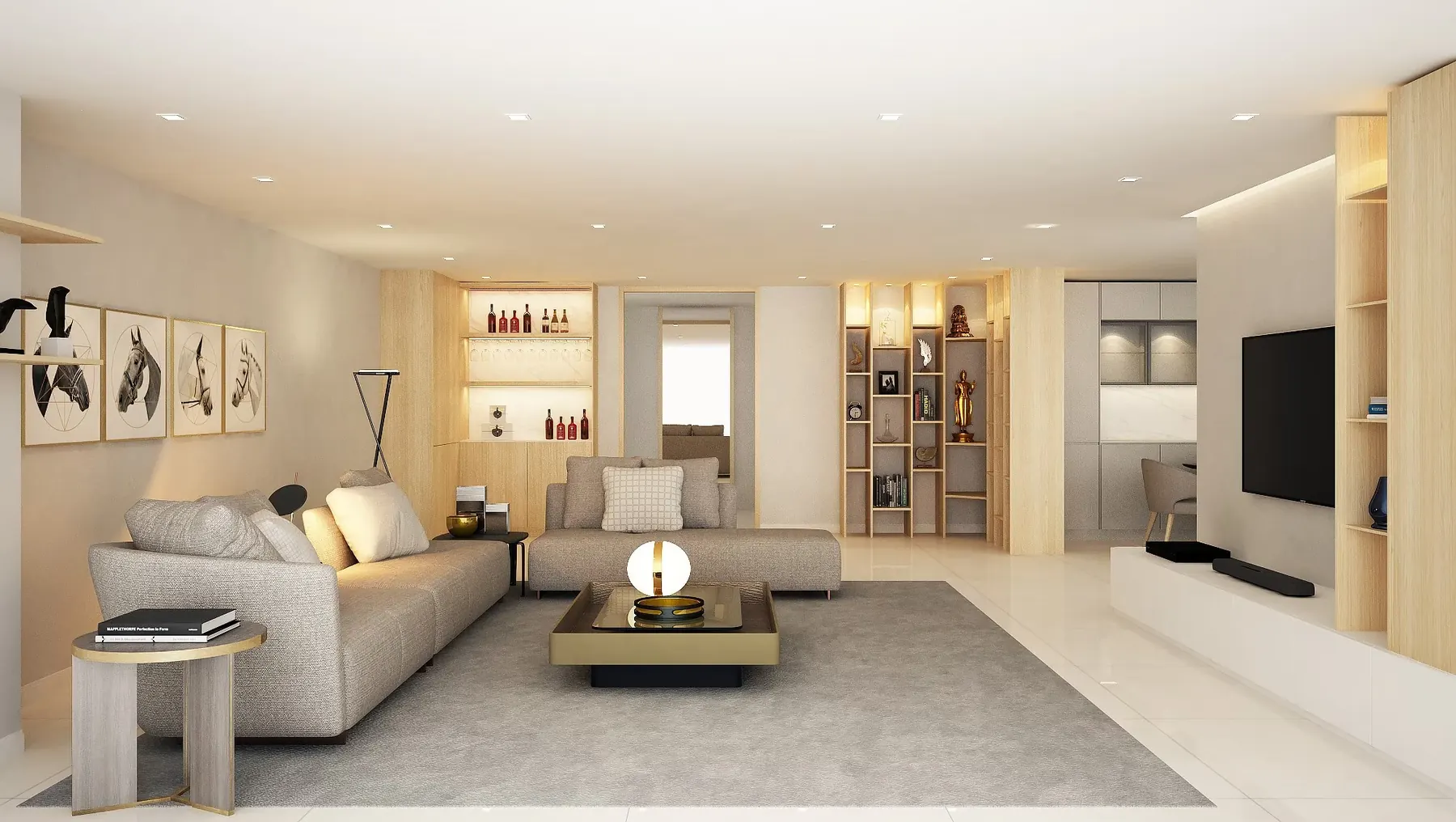
Pale timber or lacquered board for the niche, sometimes with a patterned tile or a carved panel behind the image; brass or bronze for the tray and edges; stone for the platform where the budget allows. A warm light of 2700 – 3000 K above the image, on its own switch and ideally on a dimmer, and never a cool downlight from the ceiling that lights the top of the head and shadows the face. At DS Tower 33A1 the prayer room is framed by three arched windows around a patterned tile niche; at DS Tower 10B4 the image sits in the centre of an open oak display wall, where the shelving turns it into the focal point of the room.
What it costs
A built-in prayer niche with lighting and a brass tray, made in the studio's workshop: ฿35,000 – 120,000, depending on width and finish. A separate Buddha room of 4 – 6 m² with a platform, joinery, wall finish and lighting: ฿180,000 – 450,000. A freestanding altar table from a Thai maker, for renters: ฿8,000 – 40,000, with a wall-washer light added for ฿6,000 – 12,000.